
Recharge cart
THE GOALROLETEAM MEMBERSBuild an out-of-the-box cart solution
Product design lead
Project manager, frontend developer, backend developer
Why build a cart?
Recharge had built touchpoints across nearly the entire subscriber journey—product detail pages, checkout, post-purchase pages—but one gap remained untouched: the cart. For merchants running subscriptions, the cart is one of the highest-intent moments in a buyer's session. Leaving it unaddressed meant Recharge merchants were forced to stitch together third-party cart tools alongside Recharge's subscription tooling, splitting the experience across various tools and creating fragmentation for both merchants and their shoppers.
The Recharge Cart closed that gap. It went into Early Access in March 2025 and reached General Release in July 2026, accumulating 3,464 activations and $4.15M in attributed all-time revenue along the way.
Research
Competitive landscape
To establish a scope and north star, the team audited eight cart builders in the wild, ranging from lightweight to highly configurable. We ultimately looked at two key players in the space.
Upcart offered a clean, approachable experience. They had a focused feature set that was easy to get running and visually polished. It didn't try to do everything, and that restraint was part of its appeal.
Rebuy was the opposite. They offered complex targeting logic, granular cross-sell rules, audience conditions, and extensive configurability. Powerful but less intuitive.
The team ultimately chose simplicity as our north star. Given Recharge's merchant base and the constraint of building inside Flows, a simpler, well-executed cart was more likely to see adoption than a feature-packed one that demanded significant setup investment.
Merchant interviews
Aside from just looking at cart offerings in the wild, we wanted to chat with our actual merchants about what they needed from a cart. A few consistent themes emerged:
Subscription upgrade prompts were a top request. Rebuy's "upgrade to subscription" in-cart nudge was specifically cited as something merchants valued and wanted from Recharge natively.
Cross-sells and upsells were essential, though needs varied. Some wanted simple product recommendations. Others wanted Rebuy-style rules ("show this product only if the cart contains X").
Buy more incentives ("Add another product and get X% off") came up multiple times.
Tech consolidation was a recurring theme. Merchants expressed real frustration at managing cart logic in one tool and subscription logic in another. The ideal was a single place where both lived together.
Custom cart complications were frustrating. Merchants who had built custom carts reported that upsell integrations frequently broke or had inconsistent behavior, and they wanted something more reliable.
Early design decisions
The constraint—a flows canvas
We explored a few different options at first: a builder, a form, and a flows canvas
The direction from stakeholders, however, was clear: the cart had to live within Recharge's existing Flows canvas. This was a meaningful constraint. Flows was designed around a node-based model where merchants built sequences of conditional logic and actions. Building a cart within that paradigm meant the design couldn't assume a linear setup flow, and it had to feel native to how merchants already thought about Flows.
Cart builder explorationCart form explorationNode architecture decisions
One of the more consequential design decisions was how to represent the cart within the Flows canvas. Historically, Flows had used separate nodes for distinct action types…a dedicated upsell node, a cross-sell node, and so on. Extending that pattern to the cart would have meant separate nodes for each cart capability.
The team explored this approach, but merchant feedback from existing Flows usage pointed in another direction: separate nodes for similar actions were a common source of confusion. Merchants lost track of which node did what.
The decision was to consolidate everything into a single cart node. All cart behaviors—drawer configuration, upsells, cross-sells, free shipping incentives—would be configured in one place. This traded some of the modularity of the multi-node approach for a more centralized, understandable mental model, and it aligned better with how merchants actually thought about their cart as a unified experience rather than a collection of independent widgets. We also thought this would better set merchants up for split testing, where they wouldn’t have to have a bunch of separate nodes in order to run a simple split test.
The designs
What would bring the most early value?
Cart was new territory for us, and there was hesitation about touching such a high impact area of a shopper’s journey. We had to scope down our initial designs to what would give the greatest impact in the shortest amount of time.
From merchants, we learned that upselling to a subscription and offering recommended products were top of mind. Given the complexity of recommendations, we decided to start with a simple upsell to subscription.
Cart nodeUpsell configurationEnablement
After launch into Early Access, the product owner and I conducted 15+ enablement calls with merchants. These were hands-on sessions to help them configure and activate their carts. These calls were more diagnostic than typical onboarding: merchants came with real storefronts, real themes, and real edge cases.
A consistent category of issues surfaced: theming conflicts. Merchant themes varied significantly, and with this variance came z-index struggles, competing widgets, and other nuances. This wasn't a flaw in the concept, but it was a real friction point that was slowing activation. With so many Shopify themes and widgets, it was difficult to solve for every single edge case.
Tackling the edge cases
Two solutions emerged from those learnings:
Advanced settings: an expanded set of controls that gave merchants the ability to override some of their theme issues.
A cart analyzer tool: a diagnostic utility that could identify and surface theming conflicts, helping merchants (and the team) understand what needed adjustment before going live.
Together, these reduced the time and effort required to get from "enabled" to "live and looking correct."
Advanced settings panel and cart analyzer toolResults
The cart went into Early Access in March 2025. Early activations were modest as expected—11 in March, building to 65 by June. July 2025 saw the first significant spike (316 activations), corresponding with broader rollout and the first wave of enablement calls.
Growth continued steadily through the rest of 2025 and into 2026, reaching a cumulative 3,464 activations by July 2026 — the month of General Release.
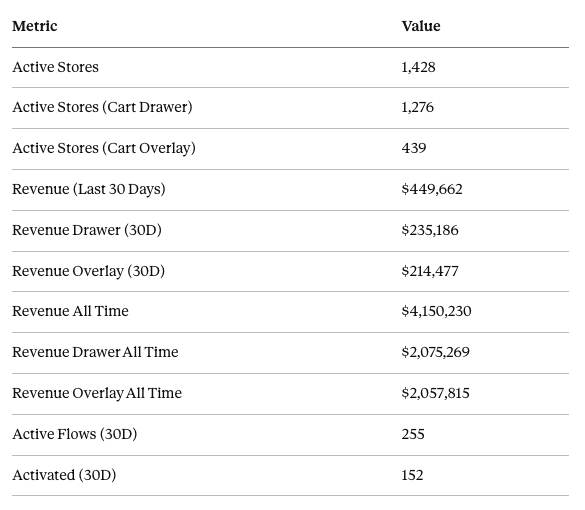
Stats from our internal Looker dashboardThe Recharge Cart required navigating a real tension: merchants wanted something powerful enough to replace dedicated cart tools, but the team was building inside a canvas paradigm that wasn't designed with cart configuration in mind. Choosing simplicity as the north star was an important decision. It kept scope manageable and pushed the team toward execution quality over feature breadth.
The enablement phase was as much a product research process as an onboarding effort. The theming issues discovered there shaped two features (advanced settings, cart analyzer) that materially improved activation rates. It's a reminder that the work doesn't end at launch — especially for a feature embedded in merchants' storefronts, where environment variability is high and the gap between "enabled" and "working" can be significant.
Most importantly: merchants can now run their cart and their subscriptions from the same platform. That consolidation was the core of the original ask, and it's what the cart delivers.
Where is the cart now? We’ve added the most requested features into the cart: free shipping progress bars, upsells, cross-sells, and a tiered progress bar. We’ve built analytics as well.
The cart building experienceAnalytics